
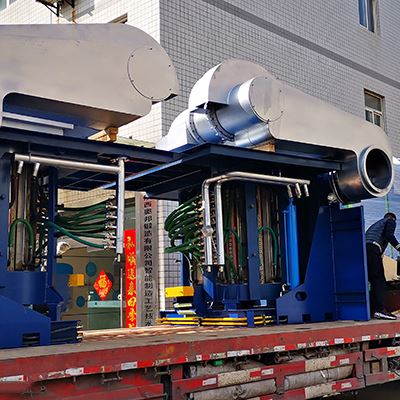
Induction Furnace For Forging
Application: Induction furnace for forging.
Send Inquiry
Product Details ofInduction Furnace For Forging

Induction furnace for forging development
The coreless induction principle is adopted by Induction furnace for forging.
After the period of coreless induction furnace, Next came the era of line-frequency (LF) coreless induction furnaces. Since line-frequency furnaces can be connected directly to the 50 Hz or 60 Hz main power grid, line-frequency furnaces experienced a period of rapid development as melting equipment in the foundry industry. This development reached a temporary climax in 1970 with the installation of a line-frequency furnace with a capacity of 60 t, a power of 21 MW, and an operating frequency of 60 Hz. Thereafter, induction melting gradually became an economically viable alternative technology to cupolas in the foundry industry, and it could also replace most gas or oil furnaces used for melting non-ferrous metals. At that time, the disadvantage of induction melting furnaces was that they required residual-liquid mode melting to achieve economically acceptable energy consumption. On the one hand, this resulted in a small tapped quantity; on the other hand, it also required a prior charge drying process to ensure operational reliability.
In the early 1980s, with the development of thyristor technology, induction melting achieved new development and succeeded in several respects: the conversion efficiency increased from about 60% at that time to about 80%, reaching 97–98%. At the same time, operational reliability and availability were very high, and procurement costs were halved. Compared with line-frequency furnaces, the higher the coil current frequency and the greater the adaptability, the more a converter-type coreless furnace of the same capacity could be operated at about three times the furnace power level without reducing melting performance.
For channel induction furnaces, the power that could be input had long been limited, mainly because of the limited service life of the inductor refractory material. In the 1980s, owing to breakthroughs in the service life of lining materials, the usable power of channel induction furnaces increased significantly, and the service life of the lining was also extended, especially for the melting of non-ferrous metals. Compared with crucible induction furnaces, channel induction furnaces can only use a lower power density because of their structural characteristics. Their characteristic feature is that a large-capacity furnace body can be combined with the siphon principle and a closed pressurized furnace chamber design (used for pouring furnaces). This furnace type is accordingly also very suitable for storing large amounts of molten iron. In addition, channel induction furnaces also have advantages when used for melting non-ferrous metals, because their high electrical efficiency provides a good return with low energy consumption.
Currently the Induction furnace for forging is widely used.
Hot Tags: induction furnace for forging, China induction furnace for forging manufacturers, suppliers, factory, automated induction melting furnace, batch induction melting furnace, induction cast iron melting furnace, induction melting system, Steel Shell Furnace, Zinc Melting Furnace
Send Inquiry
