
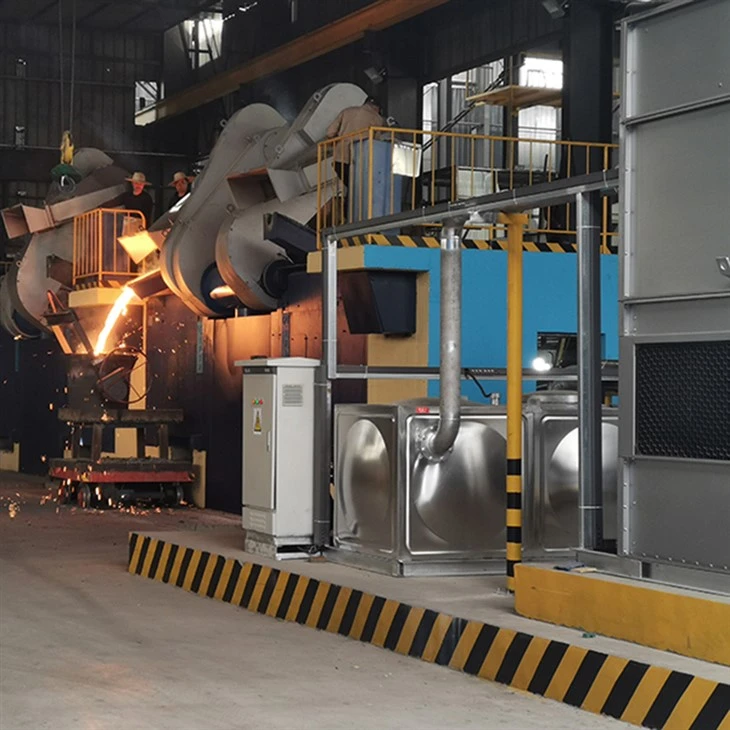
Induction Casting Furnace
Rated capacity: 0.5ton to 60 tons.
Send Inquiry
Product Details ofInduction Casting Furnace

Medium frequency induction melting furnace:Mains-Frequency and Medium-Frequency Power Supply Connections
The current and voltage of Induction casting furnace can also automatically adapt to load variations caused by the amount of charge material and melt in the coil. This allows constant-power regulation to be carried out in a simple manner in the power circuit. As a result, the rated power can actually be used for every state of the material being melted in the crucible, since the power delivered to the furnace is generated either at a high or low current of the inductor converter, or when the temperature of the melting furnace is below the Curie point: if the charge material is below the Curie point, it has a low impedance owing to its high magnetic permeability, and the frequency is low while the current is high. After the Curie temperature (768 °C) is reached, the impedance of the charge melt depends more or less on its bulk density, so full power is reached at low current, low frequency and maximum voltage.
Conversely, when Induction casting furnace is full of melt, a low impedance again occurs, and rated power is reached at high current, low voltage and high frequency. The load curve is shown as a function of the current and voltage of an induction variable-frequency power supply with constant load regulation. Thus, during full-power melting operation, the current and voltage are each 70% to 100% of their rated values. This variable-frequency power supply of Induction casting furnace is a thyristor-type variable-frequency power supply, with current power outputs of up to 42,000 kW. An example of a 40 MW variable-frequency power supply is shown. This power can therefore actually be used for various states of the charge in a coreless melting furnace.
variable-frequency power supply of Induction casting furnace
Compared with conventional mains-frequency (LF) furnaces, the constant power provided by the variable-frequency power supply has the following main advantages: the variable oscillating circuit with a higher frequency enables a medium-frequency (MF) Induction casting furnace to operate intermittently, so that at the beginning of each heat there is no need to use the residual melt left from the previous heat, and new charge can be directly charged for melting without affecting any capability in terms of melting performance. The same capacity can also be equipped with multiple times the power input, thereby increasing the power density.
Hot Tags: induction casting furnace, China induction casting furnace manufacturers, suppliers, factory, commercial induction furnace, Copper Smelting Furnace, Coreless Induction Furnace, Intermediate Frequency Induction Furnace, Medium Frequency Furnace, Steel Melting Induction Furnace
Previous
Igbt FurnaceSend Inquiry
